Showing posts with label Urban. Show all posts

Friday, January 14, 2011

Buckner Building: The Winter Palace

During the middle of last winter i was contacted by a Canadian author. He was interested in a picture from my Buckner Building Post a few years ago. In particular, he was interested in calcite formations leaching out of the concrete ceiling. He was working on a book related to that subject. Unfortunately, i didn't have a full resolution file of the image he wanted, in fact, I didn't even take the picture, Maree did, so i told him i'd just go take a new picture of it, and look for similar items of interest while i was in there.

The Green Room

It was the dead of winter, early February. I had never been to Whittier in winter, because..... well.... there's absolutely no reason to ever go to Whittier in winter. But i got lucky. The timing worked out so that when i was able to go out we had a freak warm front complete with Chinook winds. The temperature that day was about 42 degrees, delightful!

Since the Buckner Building is condemned, the snow plows ignore it. There are no nice shoveled entryways, you have to climb up out of the street and find a way in.

 This was the first room i entered from the outside. Looked like a cafeteria.

The warm weather of course made the ice roads in Whittier extremely slippery, I was wearing some grippy springs on my shoes (they were a lifesaver) but i hadn't accounted for the amount of snow Whittier gets in winter. They had over 5 feet of snow when i arrived. Many of the first floor rooms had snow ramps coming in through the windows, and i had to use one of these to get inside.

 I believe this was part of the adjoining kitchen area. Beyond this room it was very dark for a long time of searching.

These rooms divided by the the joints were cool because the snow on the ground in many of them was so clean. The room would generally be very dark and the light would be coming down through the joint illuminating this very pure looking snow.

As i've mentioned before, much of the Buckner Building is flooded. I wondered what it would be like in winter, and, as i had heard, it was very slippery. There was about two inches of solid ice in the flooded areas, and the warm weather had melted a few millimeters on the surface. This made the ice a mirror under the right lighting conditions. It was pretty cool.

 This time i found the rumored jail! The jail had some very tall, narrow cells in one part of it.

In a dark area of the building this single wall was illuminated by a joint in the ceiling. Some very strange stuff was going on with this wall. It looks blurry but it's not. On the right are calcite formations and everywhere else are strange ice formations.

Deeper in the jail. I brought a remote flash that i was playing with. All these half open doors are frozen into the floor.

From that point on i spent the next few hours looking for the calcite formation. I couldn't find it anywhere. After about two hours of wandering around i heard other people. I ended up coming upon them in a large dry area on the third floor.  They were doing some kind of teenage goth fashion model shoot. We talked a little and i could tell they were familiar with the building, but they had never seen what i was looking for.  Eventually i had systematically explored the first 4 floors of the building and it was almost sunset. The last place i decided to check out i found it!  Maree's description, from what she could remember, was off by 3 floors.

Some jerk left the door open to the high radiation area.

Also of note: I found the floor where the elevator is open. No way was i going in there. The sign inside says "Off Limits To All Troops."

This is what all the effort was for. It might seem strange, but it's really pretty rare to see a door with a complete calcium column attaching it to the ceiling. I was glad i brought the flash because it was pitch black here.

 In a nearby shower room i found these light fixtures. If you look close at the distant one you can see..... 

A light bulb encased in stone! That's not wax or paint, it's calcium carbonate. I don't know what's crazier, a light bulb inside rock or an unbroken light bulb in the Buckner Building.

So i got my shots and had to run back through the building to get to my car in time to make the next tunnel opening. The light would be gone soon and i didn't want to be stuck in Whittier in the dark. The fashion shoot guys got out right before me. I was stuck behind their truck the whole way back to town. It was a good time.

On last look before i headed back through the train tunnel. It turned out to be a nice sunset that day.

Saturday, January 1, 2011

The Lihue Sugar Mill


Kauai and the other Hawaiian islands used to be major producers of sugar. There are irrigation canals (like the one we swam at) all over the island to provide water for sugar fields and electricity at several mill sites. The Lihue Sugar Mill on Kauai began, incredibly,  in the mid 1800's, and continued to produce sugar until it was shut down in 2001.


 The following history is from The International Directory of Company Histories, by Gale:

  "In 1849 a German ship captain named Heinrich Hackfeld docked his 156-ton boat Wilhelmine in Hawaii after a 238-day journey from Bremen, Germany. After deciding to become a permanent resident, Hackfeld opened a general store which became very popular with the imported laborers who worked on the islands' isolated plantations. Hackfeld's small venture quickly expanded into other lines of business, including boardinghouses and real estate. Hackfeld later opened a trading house, exporting Hawaii's primary agricultural product, sugar, and importing building materials. Hackfeld's company became one of the largest in Hawaii, operating retail stores and hotels, trading a wider variety of products, and purchasing thousands of acres of property. Several years later Hackfeld died and ownership of the company passed to his family."


This area near the front of the main building looked like a shop.

  "In July 1918, soon after the United States became involved in World War I, the American Alien Property Custodian confiscated H. Hackfeld & Company on the grounds that it was owned by "enemy aliens." All of the company's assets were taken over by a group of competitors, including Castle & Cooke, Alexander & Baldwin, and C. Brewer. The company was incorporated and its name was changed to American Factors (a factor is a commissioned agent), and its chain of B.F. Ehlers retailing outlets was renamed "Liberty House." Under the new management American Factors became more involved in sugar production. Demand for sugar remained high during the Great Depression and World War II, which kept American Factors profitable and allowed it to continue paying dividends to stockholders."

 These things must have had conveyor builts on them originally. There were sugar cane husks lying all over the bottom of the machinery.


  "Although it continued to diversify during the 1950s, American Factors remained primarily involved with the production of sugar. However, in 1959, the same year Hawaii was made a state, airline companies acquired long-range passenger jetliners which made Hawaii suddenly more accessible to the American vacationer. Just as suddenly, demand for hotel space and land began to increase. As a major landowne, American Factors recognized this as an opportunity to exploit its hotel and lodging interests. Many of its existing properties were improved, additional facilities were constructed, and several parcels of undeveloped land were sold to developers at a sizable profit."

On one of the highest floors were large empty foundations of machinery or tanks that had been removed.


You can continue to read the history of the company up the the present day here, but what happened was that due to changing political and economic environments, and debts, the company entered a long decline (for 30 years), and eventually got out of it's sugar production operations. What was of interest to me, was that the company at one point bought a hotel company called Fred Harvey. I used to work for Fred Harvey when they operated the hotels on the rim of the Grand Canyon, so it was a big surprise to find i had a connection to the company that built the Sugar Mills in Kauai.

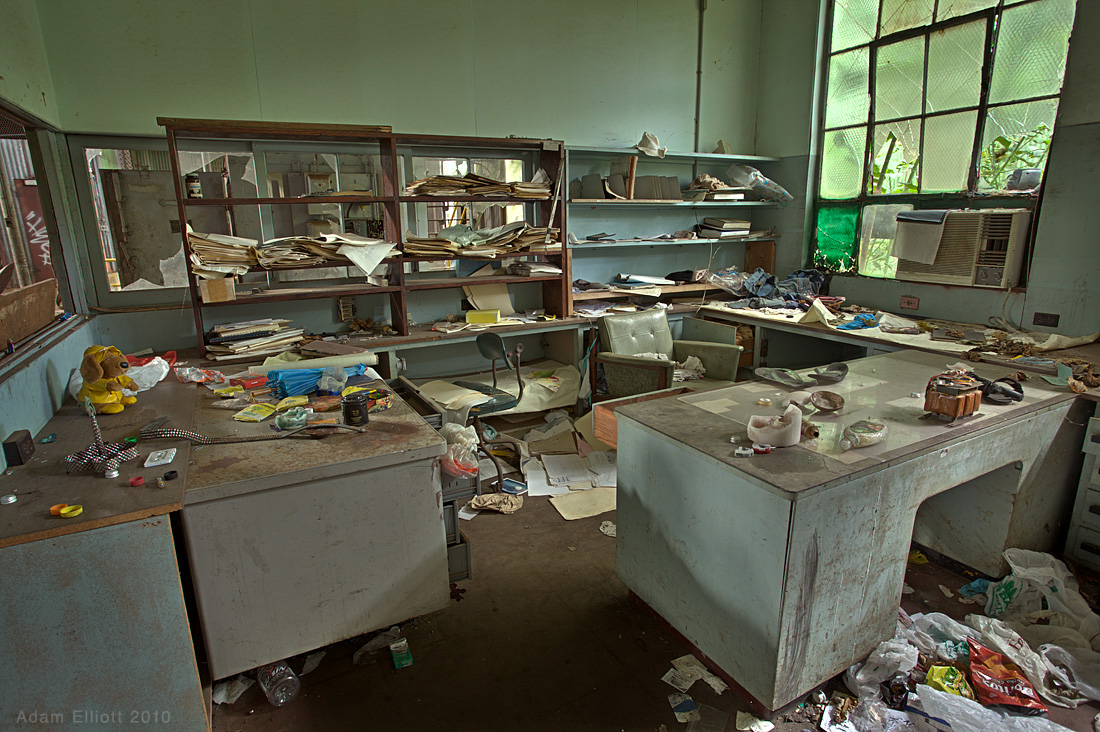
These looked like boilers to me. There were a lot of electronic panels up here, and this is where the homeless camp was too.


The Mill is impossible to miss any time you drive by Lihue. There is a large conveyor belt covered with impenetrable plants and vines, that goes right over the road. Eventually we couldn't resist and decided to take a look at it one day. It's a huge operation, with the main factory being 5 or 6 stories high, and numerous other buildings nearby.

 The floor was not safe here. In the distance roots from plants were stretching all the way from the roof down to the ground.

Outside was an enclosed open air area that was far more decayed, and overgrown by plants. These may have been an older kind of boiler or oven. Underneath they had fire kilns.

On one of the upper floors we discovered that the factory is occupied by homeless people. We found a camp of sorts with beds, a cooking area, books, even drawings. It was all rather filthy, and the people who occupied it foolishly threw all their garbage down a caged (as in open air) elevator shaft, leaving it to rot and seriously stink up that whole area of the building, right next to where they slept.


 This office looked like it was very recently occupied.

There were, what looked like child's drawings inside this first aid room.

Maree was sure the homeless people were going to come back and kill us, so she made me stop taking pictures long before we'd seen everything. A few striking things about the interior were that in the "husking and crushing" area there were still husks of sugar cane lying all over the machinery. There was also an interesting sub-floor area that had water flowing through canals in pitch black darkness, in some places making very strange noises. Below are some pictures Maree took.

There were a disturbing number of women's shoes on one floor of the building.

The sub level was very dark. Me in a flash.

The homeless camp.


Some parts were so overgrown they were nearly inaccessible. I can't believe the factory was just shut down in 2001.

Saturday, April 17, 2010

Arctic Valley Missile Base


During the cold war the United States and Canada developed a cooperative defense system called the Joint Air Defense Operation. I don't know much about it, but from what i understand it was a network of radar and missile sites. The idea was to protect our countries from an attack by Russian bombers. I don't know if the sites included nuclear missiles. I was surprised how little information i found online in the time i had to investigate.

 Due to the effects of the cold war the base is eternally shrouded in thick smog.

  A reconnaissance photo of my approach.

The main entrance and guard shack.

There is an old JADO missile site above Anchorage, on the mountain top at Arctic Valley. I had always heard this was a "secret" base, with "secret" tunnels and whatnot. As far as being a secret, it's in plain view over the city and shares the peaks with a public ski slope and some radio towers. It's often a good landmark to let you know when you're getting close to town.


One summer during a week too smokey for hiking i decided i would go check it out and see what kind of "secrets" it harbored. It's on top of a mountain but from the ski resort it's not a long hike, maybe 1,200 vertical feet and less than a mile of walking. Still, the smoke was killing me. I couldn't believe how much it affected my lungs. Everyone i passed on the trail seemed equally surprised. I thought it would be a good way to get some exercise in poor air conditions because it was so short, but once i was there i realized the net effect on my health would be negative.


Most everything of interest had been removed long ago.

Once at the top i noticed two things. What i had always thought were the silos that everyone mentioned were actually radar towers, and after being abandoned for decades there now appeared to be a crew of people working on them. As soon as i set foot on the road a truck was driving by and stopped to yell at me. The guy was very threatening and acting like i was lucky that i was being shot on site. What made me mad about this guy was that he wasn't even in the military. He appeared to just be some painting contractor. So that was annoying, to have hiked all the way up there just to be immediately turned around.


As soon as i started heading back, a mother with her two kids made it up to the road. Yes, the abandoned cold war missile silos are the type of place that moms go with their children to have a picnic lunch. The guys who were working up there were extremely nice to them and seemed saddened to tell them they had to turn around. I guess i should be a mom. Weeks later i read in the paper that North Korea has caused renewed interest in the old base, and there are indeed renovations going on. Just my luck, i decide to go to a popular site that's been abandoned for decades, and the day i get there is the day they decide to open it back up.


 The bay that housed the missiles.

I wasn't deterred, and simply went to another area  of the base where there were no workers and it was easy to stay out of site. This area seemed to be the bulk of the original base, and it was here that i found the actual missile hangers (not silos). The first day by the time i found my way in i got hungry and had to leave. A few weeks later i returned under the cover of fog, so those workers couldnt' even see me at all.


The site up close is generally gutted, with anything of interest having been removed long ago. I did find an interrogation room and a lot of impressive blast doors. And, the rumor of underground passages turned out to be true. I found several tunnels, but they had been plugged with large rocks and dirt. I don't think they were a secret, more likely they were a comfortable way to get from building to building when there were arctic blizzards on the mountaintop.

 The outside of one of the missile bays.

 This is an old steam powered furnace or heat and power.